
Hell Mode for Newcomers: Surviving an AI Era with No Moat
/ 5 min read
Table of Contents
With the rise of GPT, new products are popping up everywhere. Engineers, product managers, and investors are all feeling the anxiety. I’ve seen (and felt) it repeatedly—Twitter polls asking “are you anxious?” The anxiety boils down to two things: extreme product homogeneity with no defensible moat, and AI flattening industries that once required years of accumulated expertise.
Two common mindsets:
- Programmers (and most human professions) will be entirely replaced
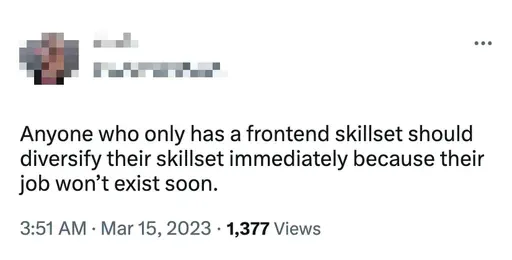
- The “End of Front-End Development” view: this has happened several times before, it’s not different this time, and it will happen again
As a conservative optimist, I generally “choose” to believe things will get better—but before choosing optimism, I try to think through the worst case (an optimistic coward…? LOL). So let me explore: if things really are this bleak, what can individuals do?
Point 1 — Small AI Teams Have No Moat, So Stop Chasing One
My take is fairly subjective but grim: small AI teams (latecomers) have virtually no chance of building any traditional moat (technology, brand, scale, distribution, ecosystem).
A moat is pricing power. Building one requires self-reinforcing feedback loops—the Matthew effect: more users → more data → better algorithms → better service → more users. For an AI product, self-reinforcement comes from combining: data, algorithms/pipeline, and user experience. The corresponding opportunities for small AI startups:
- Integrate information sources that big tech lacks, generating proprietary data
- Algorithms or pipelines for a specific niche
- User experience for a specific niche
But in the age of general AGI, will these opportunities survive?
- With AGI, integrating information sources goes from labor-intensive to plug-and-play. Companies like OpenAI can integrate data sources at near-zero marginal cost
- If big companies have this integration capability, small companies won’t accumulate enough proprietary data (and even if they do, maybe only a few weeks’ worth—not enough)
The contentious question: how competitive are niche-specific algorithms, pipelines, and UX really?
My view: niches offer short-term opportunity, but long-term it’s like the “AI can’t draw hands” problem—it’ll get solved quickly. Imagine your team invests heavily in fixing the “drawing hands” problem, enjoys a few months of popularity, then a new open-source tool or paper or model drops and those barriers vanish overnight.
The existence window of a “niche” itself is shrinking dramatically. Building your moat on a niche is like those iOS third-party apps that got sherlock’d when Apple shipped native features—except in the strong AI era, this cycle compresses from years to weeks.
Conclusion: small companies can’t accumulate moats, so just give up and think of something else.
Point 2 — If AI Is Leverage, “Connection” Gets Massively Amplified
This isn’t new—it’s almost cliché. Pre-internet, the average person encountered a few hundred people in a lifetime. Today, more people scroll past your eyes daily than that. With recommendation algorithms, some people appear before millions of strangers every day.
Take livestream shopping influencers. People don’t buy because of the brand—they buy because of the person. This trend was already visible in the e-commerce livestreaming boom—people don’t care what brand it is, they care who they’re buying from.
Of course, connection alone has a short half-life—like washed-up influencers, if you don’t consistently deliver value, all those connections become dead links. An effective approach balances value creation with connection scale. A prime example is @levelsio—260K Twitter followers, nearly $1M annual revenue, all from one person’s continuous investment.
Many on Twitter look down on levelsio, saying he just leverages his follower count for instant network effects, while his technical skills and product quality are mediocre. That’s “unfair” to other indie developers—when levelsio says “you don’t need a team, just a computer and an idea, iterate fast,” it rings hollow from someone with 300K followers. But that’s exactly my point: having a 300K-follower distribution channel that triggers network effects is just as important as your tech stack—possibly more important early on.
So please, build connections: Connect! Connect! Connect by any means necessary!
Point 3 — Standing Still Means Falling Behind
I once chatted with a senior Facebook engineer whose ideal business was one where you could “sit back and count money.” Back then, Facebook’s social graph and Google’s search seemed like that. But now Google’s co-founders are back in red-alert mode. The future demands perpetual improvement—never stop, never rest. For lifelong learners this isn’t hard to accept, but for that engineer, telling him “no, you can’t find one thing that feeds you forever—even inherited wealth won’t save you” would be deeply resisted.
Even levelsio, after building million-dollar-revenue products solo, never stopped. He keeps shipping new products, keeps testing for PMF. For people like him, pausing briefly for reflection is fine (his reflection on why he caps at $100K-$1M while Lensa hits tens of millions is excellent), but resting on laurels? Too boring.
Conclusion
The era of companies and products as we knew them is over. The future belongs to super-individuals—people with extraordinary personal capabilities who are also powerful organizers and key connectors, never content to rest on past achievements.
My personal action plan: before the point of no return (maybe 5-10 years), relentlessly create value and grow my connections. The window is truly short!