#buildinpublic Has Risks You Haven't Considered
/ 2 min read
Table of Contents
This dramatic episode deserves to be documented before either party deletes their tweets.
The Two Parties
Who is @pie6k?
The creator of the popular ScreenStudio (which I also use)—a tool that brought him massive exposure and hundreds of thousands of dollars in revenue.
Who is @_justlilian?
Another indie hacker, still a student, who built Sidebird (a Twitter publishing tool). Less influence but with his own audience.
What Happened
It started when @pie6k (Adam) published a long thread. The gist: he had previously shared an idea for an automated text-video ad generator, which received massive attention and support. But he didn’t start building it right away, only to discover that someone else (@_justlilian) had already started building and pre-selling the product (~$2,000 in pre-sales—quite impressive for an indie hacker). Adam experienced firsthand the risk of sharing ideas publicly. He had mixed feelings: on one hand accepting that execution is what matters and that ideas, even if his, aren’t that important; on the other hand, feeling somewhat offended because he had essentially done free market validation for someone else.
Original thread: https://twitter.com/pie6k/status/1660008805491417090
Lilian’s product hadn’t even launched yet, but despite the high price, plenty of people had already placed orders.
In other words, Lilian saw Adam’s original tweet about the text ad video idea, built it in under two weeks, and immediately pushed it to market. This sparked Adam’s frustration.
Resolution
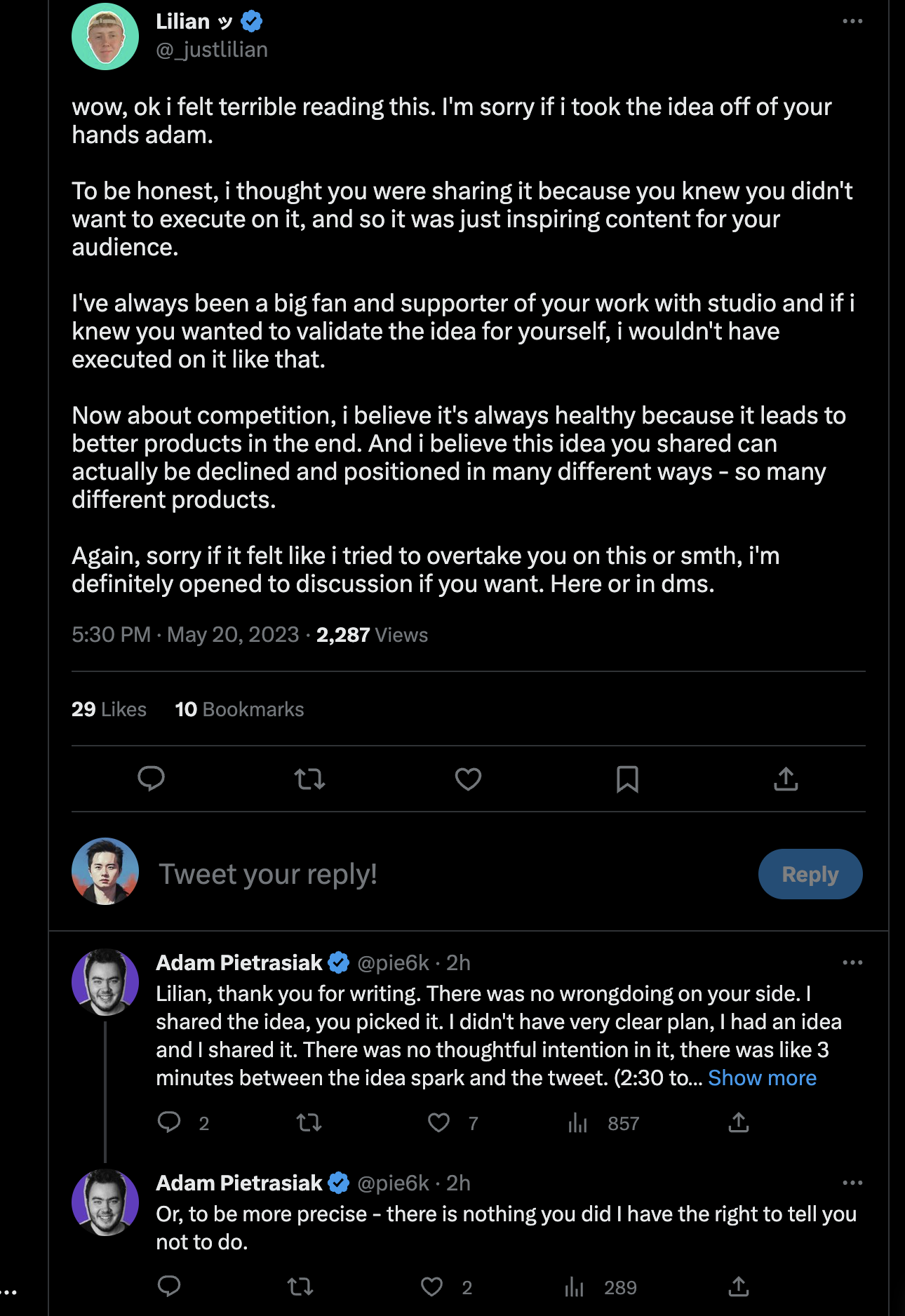
Both parties were genuinely gracious about it, which I admire.
Lilian apologized for how Adam felt. He explained that he assumed Adam shared the idea because he wasn’t planning to build it himself—just to inspire his audience. He’d always been a big fan of Adam’s work and wouldn’t have moved on it if he’d known Adam intended to build it.
Adam also acknowledged he had no right to stop Lilian and didn’t think Lilian did anything wrong.
It ended with a handshake.
Takeaway
For indie hackers who already have large followings: if you’re not sure whether you’ll build an idea yourself, casually posting it to social media is a high-risk move—you might inadvertently do early market validation for a potential competitor. And if that competitor is a strong executor, you may have just handed them a gift.
So while #buildinpublic certainly has many advantages—early user feedback, building trust, etc.—it’s not a free lunch, especially for those with large audiences. You’re in the spotlight while your competitors lurk in the shadows.